How Often to Clean Your Dryer Vent
The baseline for every home is once a year. The National Fire Protection Association and the U.S. Fire Administration both use that number. In practice, how fast lint builds up depends on how much you dry and how far the air has to travel.
| Your situation | Clean the vent |
|---|---|
| 1 to 2 people, short vent straight through an outside wall | Every 12 months |
| Family of 4 or more, 5 or more loads a week | Every 6 months |
| Pets that shed, lots of towels, bedding or fleece | Every 6 months |
| Vent runs more than 15 feet, has 2 or more elbows, or exits through the roof | Every 6 months |
| Flexible foil or plastic duct anywhere in the run | Every 6 months, and replace the duct with rigid metal |
| New dryer, or the vent has never been cleaned | Now, then on the schedule above |
If you fit two rows at once, go with the shorter interval.
Why Lint Buildup Is a Fire Hazard
Lint is cotton and polyester fiber dried to almost zero moisture. It catches fire at a low temperature, and a dryer’s heating element runs well above that. As lint coats the inside of the duct, airflow drops, drying times stretch, and heat builds up inside the dryer and the duct instead of leaving the house. When an overheated element meets a lint-packed duct, the fire travels the whole run in seconds.
The U.S. Fire Administration estimates about 2,900 home clothes dryer fires a year in the United States, and its fire prevention guidance lists failure to clean as the leading cause.
The second cost is quieter. A clogged dryer vent makes every load run longer, which wears out the heating element and the motor and shortens the life of your dryer.
Signs Your Dryer Vent Needs Cleaning
- Towels and jeans take more than one cycle to dry
- The top of the dryer and the laundry room feel hot after a load
- Clothes come out hotter than usual, or smell scorched
- The lint trap fills fast, or lint collects behind the dryer
- Little or no air moves at the outside vent hood while the dryer runs
- The flap on the outside hood stays shut, or lint is stuck in it
- A burning smell during a load (stop the dryer and unplug it)
- It has been more than a year since the last cleaning
One sign is a reason to book. Any burning smell is a reason to stop using the dryer until the vent is cleared.
Why Flower Mound Dryer Vents Clog Faster
Most homes in Flower Mound subdivisions like Bridlewood, Wellington and Lakeside DFW are two-story houses built from the 1990s on, and the laundry room is usually in the middle of the house, downstairs or up. That puts the dryer a long way from an outside wall, so the vent runs up through the wall and attic and exits through the roof. A roof vent is the hardest run a dryer can have: 20 to 30 feet of duct, three or four elbows, and a vertical lift that lets wet lint fall back and settle at every bend.
Three local extras:
- Roof vent hoods get nests. Birds and squirrels near the Cross Timbers woods and the lakes find a warm, lint-lined hood in spring and build in it. A nested vent hood blocks airflow completely.
- Summer humidity keeps lint damp. Damp lint packs into a dense mat instead of blowing out, and a 130°F attic then bakes it onto the duct wall.
- Flex duct inside the wall. Builders of that era often ran foil flex duct in the wall cavity. Its ridges catch lint, and it sags over time.
Can You Clean a Dryer Vent Yourself?
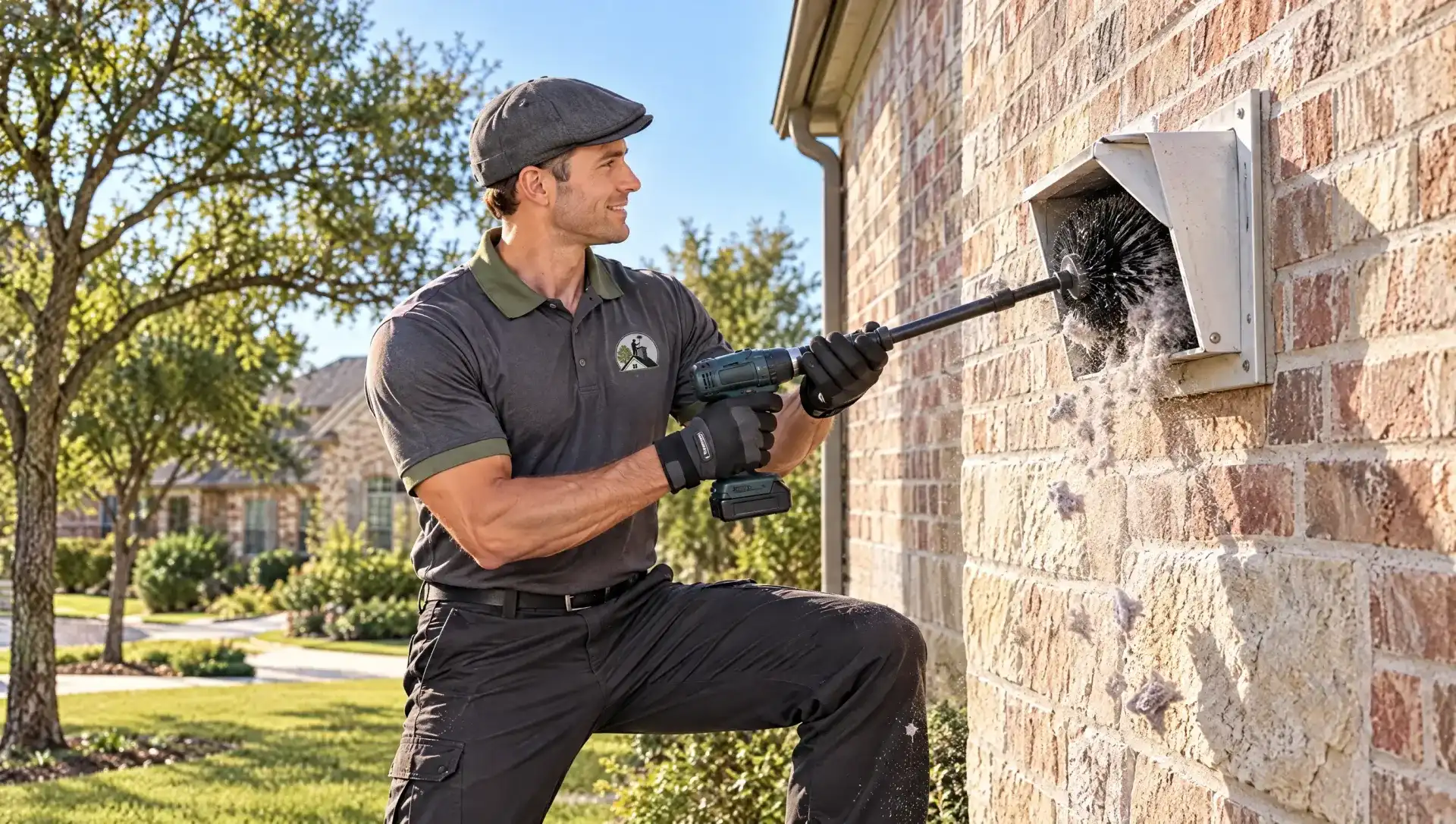
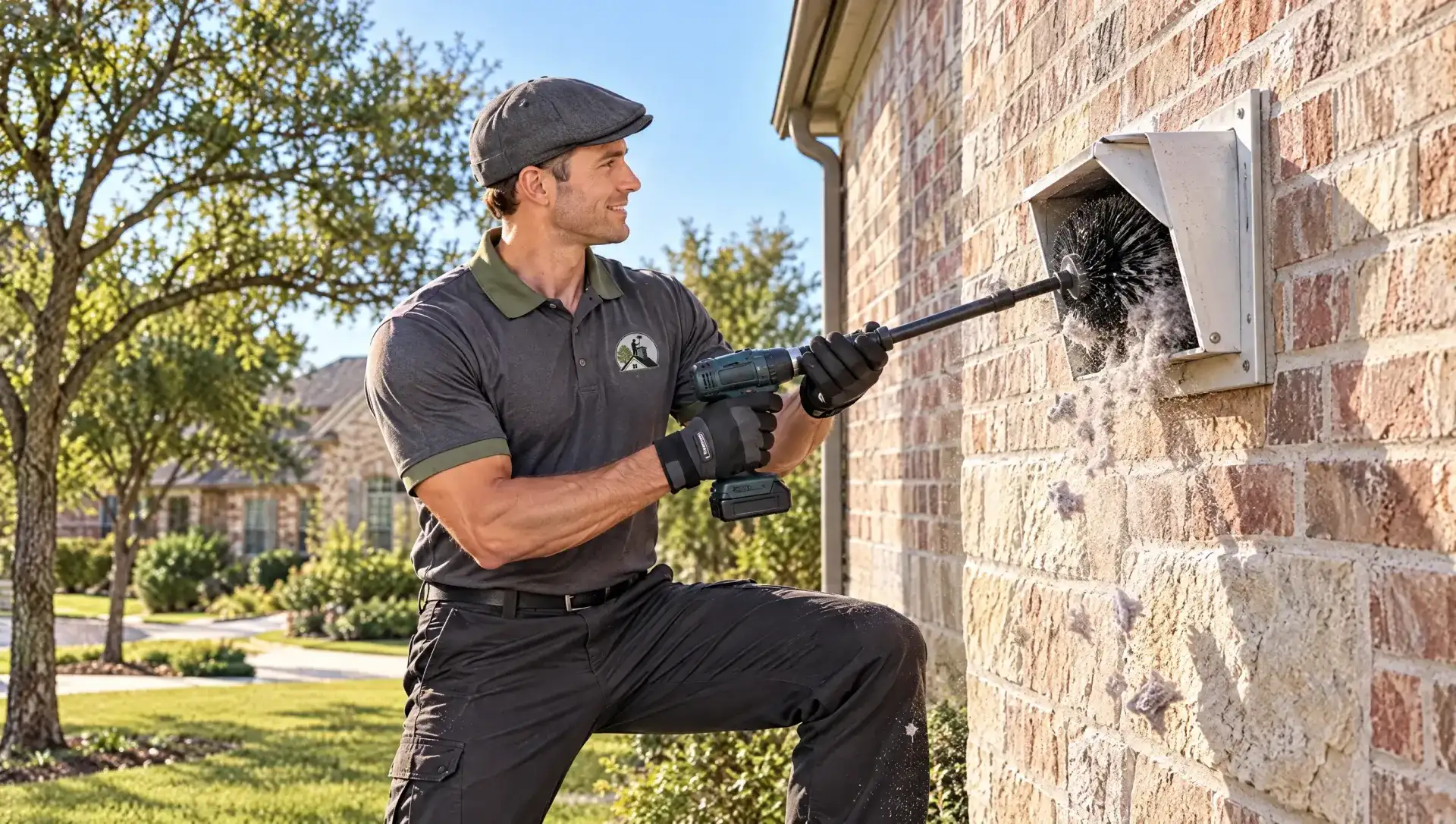
Partly. Clean the lint trap before every load, and once a season pull the dryer out, disconnect the duct and vacuum the first few feet and the dryer’s exhaust port. A brush kit on a drill handles a short, straight run through an outside wall.
What a kit will not do is clear 25 feet of duct with elbows, pull a nest out of a roof hood, or tell you whether the duct came apart inside the wall. Pushing a brush into a run with a loose joint can disconnect it and send lint into the attic. If your vent exits through the roof, or drying times do not improve after you clean what you can reach, that is the point to call.
What a Professional Dryer Vent Cleaning Includes
- Airflow check. We measure how much air comes out at the vent hood before we start, so you can see the difference after.
- Disconnect and clean at the dryer. Lint cleared from the dryer’s exhaust port and the first section of duct.
- Rotary brush the full run. A rotating brush on flexible rods goes from the dryer end to the outside hood, with a vacuum catching the lint.
- Clear the outside hood. Nest material and packed lint removed from the roof or wall hood, and the flap checked so it opens and closes.
- Reconnect and test. Duct joints reconnected with clamps or foil tape (never screws, which catch lint), the dryer run, and airflow measured again.
- Report. Before-and-after photos of what came out, and a note if the duct is damaged, undersized or should be replaced with rigid metal.
A single-dryer cleaning usually takes 45 to 90 minutes, longer for a roof vent with a nest.
Book Dryer Vent Cleaning in Flower Mound
Flower Mound Chimney Sweep Professionals offers dryer vent cleaning in Flower Mound with the same rotary tools and HEPA vacuum we bring to a chimney sweep, so many homeowners book both on one visit before the first cold front. A bird in the vent hood is handled the same way as a bird in the flue; see chimney animal removal. And if you would rather not think about it again, chimney maintenance puts the dryer vent on the same yearly schedule as the fireplace. You get a firm price before we start and photos of what came out. Veteran-owned, on Long Prairie Rd in Flower Mound, open 7 days a week from 7 AM to 8 PM. Call (817) 518-6131.