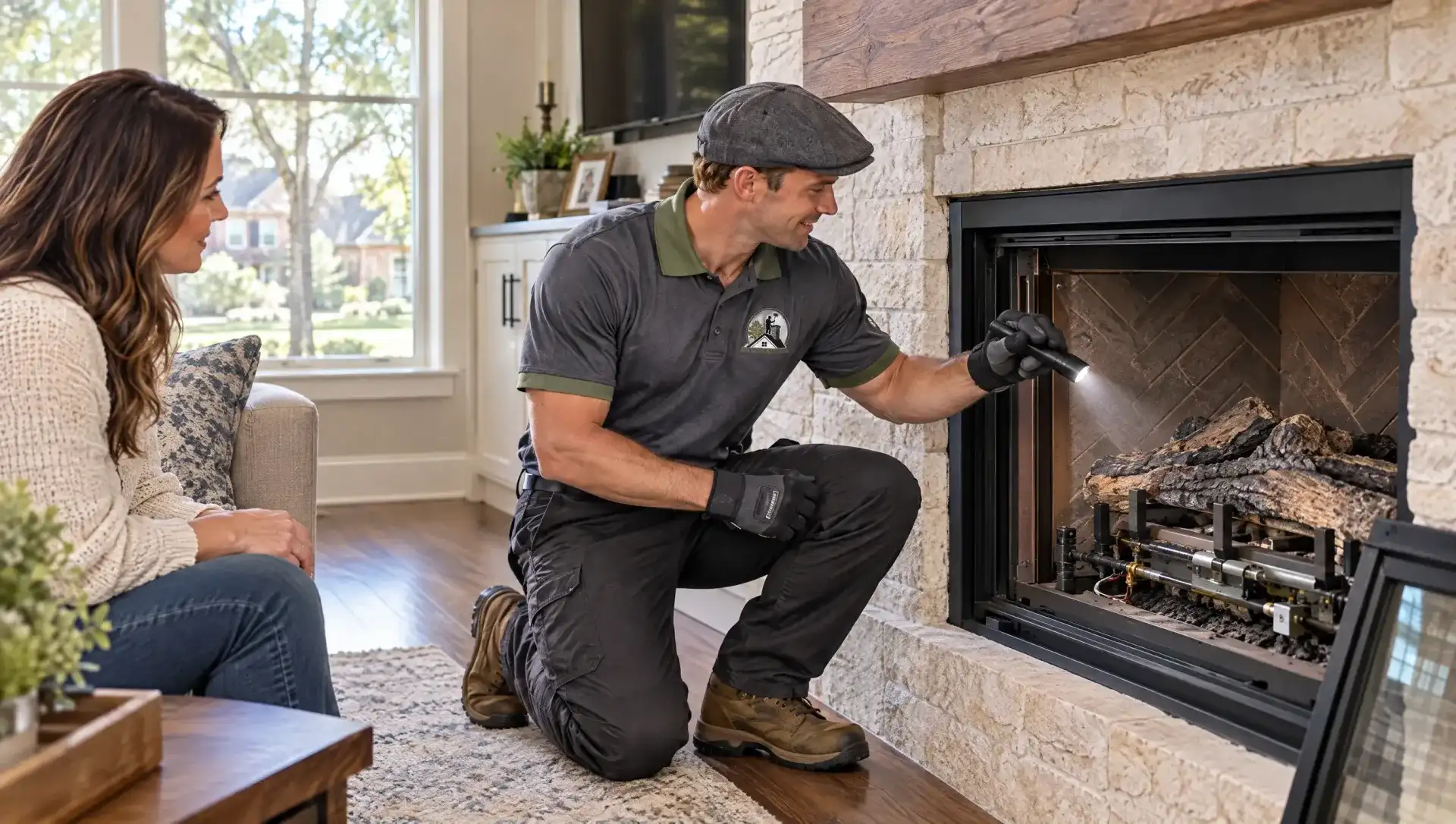
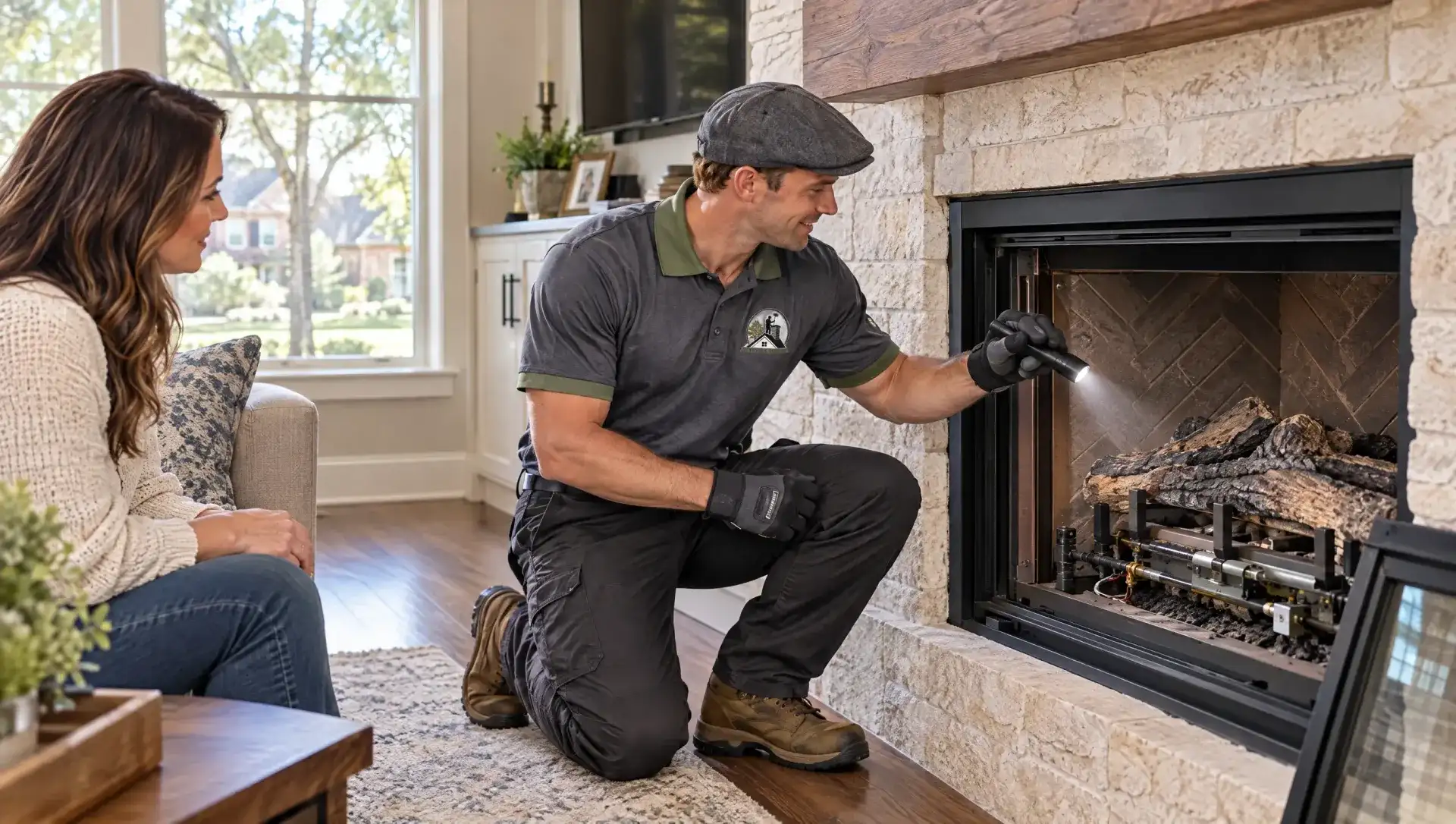
Step 1: Is Gas Reaching the Fireplace?
Start with the gas supply, because nothing else matters until gas flows. Most Flower Mound gas fireplaces have a key valve in the floor or wall beside the hearth, and many have a second shutoff valve behind the lower louver or access panel. Both must be open. A key valve is open when the slot on the key lines up with the pipe.
Then check the rest of the house. If the water heater, furnace or range runs on gas and works, the gas supply to the house is fine and the problem is at the fireplace. If nothing gas works, call your gas utility before you touch anything else.
If you smell gas at any point, stop. Leave the house and call your gas utility from outside. Do not flip switches on the way out.
Step 2: Is the Pilot Light Lit?
Open the lower panel and look for a small blue flame near the burner. That is the pilot flame. On a standing-pilot fireplace, that flame burns all the time. On a fireplace with electronic ignition, there is no standing pilot; you hear clicking when you turn it on, and the pilot lights only when you call for heat.
A standing pilot that went out is the single most common reason a gas fireplace won’t light in Flower Mound. Fireplaces here sit unused from March to November, and a draft, a summer thunderstorm that dropped the gas pressure for a moment, or a spider web in the pilot tube is enough to put it out. To relight it:
- Turn the control knob on the gas valve to OFF and wait five minutes so any gas clears.
- Turn the knob to PILOT, push it in and hold it.
- Press the igniter button (it clicks) until the pilot flame lights. Keep holding the knob for 30 to 60 seconds.
- Release the knob. If the pilot stays lit, turn the knob to ON and try the switch.
If the pilot will not light at all, gas is not reaching the pilot assembly: the valve is closed, air is in the line after a long summer, or the pilot tube is blocked. If it lights and goes out when you let go of the knob, skip to Step 4.
Step 3: Does the Wall Switch or Remote Work?
Most gas fireplaces installed since the 1990s use a millivolt system. The pilot flame heats a thermopile that makes a small electric current, and the wall switch or remote control uses that current to open the main gas valve. No batteries in the valve, no power cord. That tiny current is easy to interrupt.
Check these before calling anyone:
- Remote control: replace the batteries in the remote and in the receiver box under the fireplace. The receiver batteries are the ones everyone forgets.
- Wall switch: make sure the switch you are flipping is the fireplace switch and not a light. Some receivers have an ON/REMOTE/OFF slider that has to sit on REMOTE.
- Loose connections: the two thin wires from the gas valve to the switch sit behind the lower panel. A wire that slipped off its terminal is a two-minute fix.
- Jump test: with the pilot lit, touch the two switch wires on the valve’s TH and TH/TP terminals together with a screwdriver. If the burner lights, the switch, remote or wiring is the problem, not the fireplace.
Step 4: Thermocouple, Thermopile and a Dirty Pilot Assembly
Two small metal rods sit in the pilot flame. The thermocouple tells the gas valve the pilot is lit so it is safe to keep gas flowing. The thermopile makes the current that opens the main burner. Both fail in predictable ways:
| What happens | Likely part | What it needs |
|---|---|---|
| Pilot lights, goes out when you release the knob | Thermocouple | Tip cleaned and set back in the flame, or replaced |
| Pilot stays lit, burner will not ignite from the switch | Thermopile | Cleaned, tested for 300 millivolts or more, or replaced |
| Pilot flame is weak, yellow or blows sideways | Pilot assembly | Orifice cleared of dust, soot or a spider web; air shutter adjusted |
| Burner lights, then shuts off after a few minutes | Thermopile under load, or a failing gas valve | Load test, then valve replacement if it drops out |
A pilot assembly in a Flower Mound home collects a season of dust, pet hair and soot between fires. Gently brushing the pilot hood and the two rods with a soft brush fixes many no-light fireplaces. If the gas logs carry heavy soot, the logs are sitting off their pins or the air mixture is wrong, and that is a job for fireplace repair, not a brush.
When to Stop and Call a Technician
Some problems are not for a screwdriver and a flashlight:
- You smell gas, hear hissing, or the pilot flame is large and yellow.
- The gas valve, or the control module on an electronic-ignition fireplace, is dead. Replacing a gas valve means working on a live gas appliance.
- The fireplace lit, but the room got stuffy, your eyes stung or a carbon monoxide alarm went off. A blocked or disconnected vent can push exhaust into the room. The National Fire Protection Association’s carbon monoxide safety page explains why every home with a gas fireplace needs a CO alarm on each level.
- Any work on the gas line itself. In Texas, gas piping is done by a licensed plumber, as state law requires. We coordinate with one when the problem is upstream of the fireplace.
Gas Fireplace Repair in Flower Mound
Flower Mound Chimney Sweep Professionals provides gas fireplace repair in Flower Mound for fireplaces that will not light, will not stay lit or burn with soot. A visit covers the gas valve, pilot assembly, thermocouple, thermopile, burner, logs, switch wiring and the vent, and you get photos of what we find and a written price before any part is replaced. If the fix is a new set of gas logs, or the unit needs a full fireplace inspection before the first fire of the season, we tell you that on the spot. Veteran-owned, on Long Prairie Rd in Flower Mound, open 7 days a week from 7 AM to 8 PM. Call (817) 518-6131.